Conference held as part of World Water Day
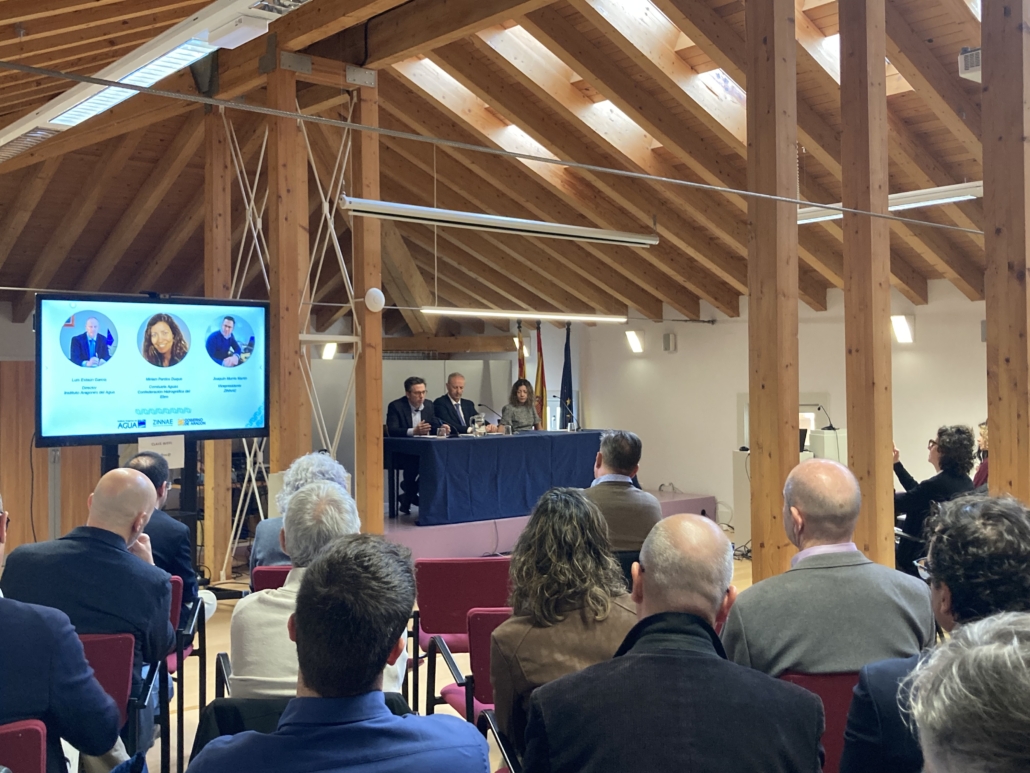
The Palace of the Marquises of Ayerbe (Casa Palafox), located in the La Alfranca nature reserve in Zaragoza, hosted a technical conference on Thursday 19 March, organised by the Instituto Aragonés del Agua and the ZINNAE cluster to mark World Water Day. The event focused on one of the major urban challenges of today: sewage system overflows and their sustainable solutions.
Under the title “Urban sewage system overflows: challenges and solutions”, the event brought together institutional representatives, technical experts, operators and municipal officials to analyse the impact of these incidents and develop more efficient management strategies.
The opening session was attended by the director of the Instituto Aragonés del Agua, Luis Estaún; the water commissioner of the Confederación Hidrográfica del Ebro, Miriam Pardos; and the vice-president of ZINNAE, Joaquín Murria, who highlighted the importance of planning, innovation and collaboration to safeguard the future of water in cities.
The first panel of the day addressed the regulatory framework and its implementation in Aragon, focusing on how European and national guidelines are translated into local management. Experts in water quality, wastewater management and infrastructure operations agreed on the need to improve the control, monitoring and adaptation of systems in the face of increasingly demanding scenarios.
Mª Ángeles Alfonso Serrano, Head of the Water Quality Department at the Confederación Hidrográfica del Ebro, outlined the progress required by the regulations approved in the latest decree of 2023, focusing particularly on municipalities with more than 50,000 inhabitants, whilst also highlighting the implications for smaller municipalities. From ECOCIUDAD, an organisation of Zaragoza City Council, the technical director, José Ignacio Castrillo Fernández, explained how the regulatory parameters are being implemented in a city such as Zaragoza. For his part, Fernando López Ribot, Head of Operations at the Instituto Aragonés del Agua and responsible for managing 269 wastewater treatment plants in municipalities across Aragon, explored the complexity and specific characteristics of small municipalities (the majority in the region) in terms of monitoring and analytical control of the operation of these facilities and the control of industrial discharges.
The second part of the meeting gave a platform to local authorities and operators, who shared their experiences and the real-world challenges they face. Among the main challenges highlighted were the age of the infrastructure, a lack of technical and human resources, difficulties in complying with regulations, and the growing impact of climate change, particularly during periods of heavy rainfall.
Mayors from the villages of Alfajarín, Torres de Berrellén, Alfamén and Ricla raised specific issues such as groundwater seepage, increased discharges and the need to modernise outdated networks. For their part, operators representing FACSA, Veolia, Gestagua and AQLARA discussed sewerage network inventories and overflow control systems, and presented solutions based on digitalisation, real-time monitoring and the use of predictive models, emphasising the key role of technological innovation in sewerage management.
The event concluded with a call to strengthen coordination between public authorities, operators and the public, as well as to promote investment and policies that would enable us to anticipate the effects of climate change. Participants agreed that sanitation systems, although invisible to most people, are essential to quality of life and urban sustainability, and that addressing the challenges they present requires a shared vision, commitment and long-term planning.
“Water always finds its way; our challenge is to be prepared to go with the flow,” was one of the closing remarks of a conference that placed water management at the heart of the public debate.